
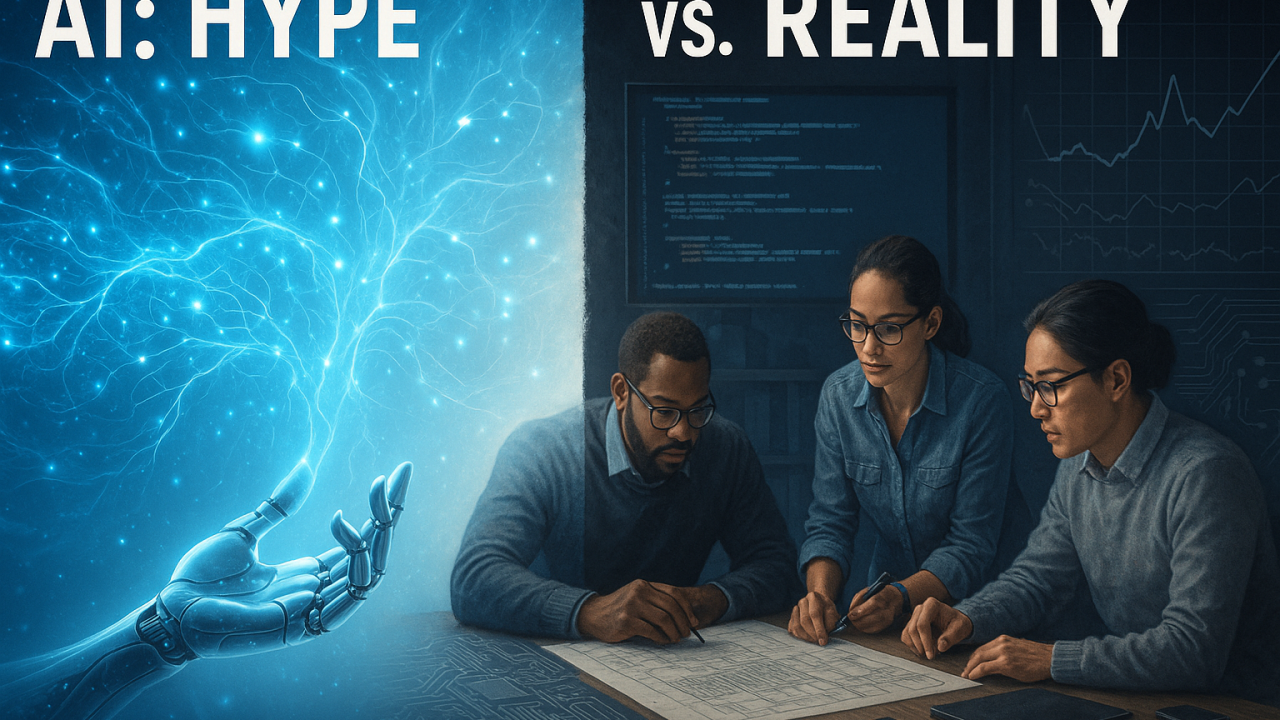
There is a version of AI that exists in press releases, TED talks, and venture capital pitch decks. In that version, we are months away from AI that can run companies, cure diseases, do all creative work, and fundamentally reshape every aspect of human civilization. It is coming. It is inevitable. Get ready.
Then there is the AI most people actually use. It writes decent first drafts. It summarizes long documents pretty well. It can explain code in plain English and draft emails faster than you can. It gets things wrong sometimes. It makes stuff up occasionally. It is useful without being magic.
The gap between these two versions has been growing, and it is worth paying attention to because the hype version has real consequences. Investors pour money into companies making promises they cannot keep. Workers in certain fields spend years anxious about being replaced by a technology that is not going to replace them in the way the headlines suggest. And people who use AI tools with inflated expectations get burned by the gap between what they thought it could do and what it actually does.
Why does the hype outpace reality so consistently? Part of it is the incentive structure. The people who benefit most from AI hype are the people who need investment, media coverage, and talent to build AI companies. Confident predictions about revolutionary change attract all three. Measured assessments of incremental progress attract none of those things. A founder who says “our model is meaningfully better than last year’s on these specific benchmarks” does not get a profile in a major magazine. A founder who says “we are on the path to artificial general intelligence” does.
Part of it is also the way AI capabilities get publicized. When a new model gets released, the benchmark results emphasize the tasks it handles well. The tasks it handles badly do not make the press release. A model that scores at the 90th percentile on a coding benchmark and produces nonsense when asked to count letters in a word will be announced as a breakthrough. The letter-counting failure is a footnote, if it gets mentioned at all.
Balanced coverage from CompassionPulse, without either dismissing the technology or exaggerating it, is harder to find than it should be. The space between “AI is going to change everything next year” and “AI is useless hype” is where most of the actual truth lives, and that space does not get nearly as many clicks.
The technology is real and it is improving. Some things that seem like science fiction today will be normal in five years. But the specific timelines and specific capabilities that get promised in the big announcements have a poor track record. Self-driving cars were supposed to be mainstream by 2020. AI was supposed to make radiologists obsolete by 2022. The underlying technology advanced. The specific predictions did not age well.
A useful habit: when someone makes a specific confident prediction about what AI will do by a specific date, write it down. Set a reminder. Check back. The track record will quickly recalibrate how much weight you give future predictions from the same source.